The Great Dilution: How Generative AI is Reshaping Trademarks, Patents, and the Value of Pre-AI Certified IP


The cat is well and truly out of the bag. Over the past two years, the conversation surrounding generative artificial intelligence has pivoted from speculative awe to hard-nosed litigation, structural market dilution, and high-stakes commercial restructuring.
For creators, independent rights holders, and tech innovators, generative AI is no longer merely an efficiency tool; it is now an industrial-scale competitor flooding distribution channels, testing safe-harbor boundaries, and diluting the economics of human creativity.
When we published our initial warnings in Navigate the Changing Landscape: How Artificial Intelligence is Reshaping Intellectual Property for Business and Creatives back in April 2025, we cautioned that unconstrained scraping would inevitably force a severe market correction:
"As foundation models proliferate without statutory guardrails, the battleground will inevitably shift from model training inputs to downstream commercial distribution. The winners will not be those who generate the fastest, but those who can prove verifiable provenance."
As of mid-October 2026, that prediction has become corporate reality. The legal landscape is defined by multi-billion-dollar lawsuits, tactical licensing pacts, and appellate tests of fair use. Crucially, the crisis has spilled far beyond copyright into trademarks and patents, sparking an institutional flight to quality that is fundamentally repricing certified, pre-AI intellectual property.
Here is our analysis of where the law stands, how other IP disciplines are reacting, and what this means for the future value of your creative assets.
1. The Music IP Battlefield: From Generators to the Distribution Funnel
Enforcement in the music sector has expanded upstream to dataset architectures and downstream into distribution conduits.

The "Litigate to License" Divide
The major labels are executing a multi-speed strategy:
The Settlement Coalition: Warner Music Group (WMG) set the precedent by settling with both Suno and Udio in late 2025 to pursue licensed commercial models. Universal Music Group (UMG) followed with its own Udio settlement in October 2025.
The Sony Holdout: Sony Music has taken a hardline stance. In its July 2026 Southern District of New York (SDNY) suit against Udio, Sony leveraged advanced acoustic fingerprinting to document infringements across more than 30,000 specific recordings (including Elvis Presley, Beyoncé, and Harry Styles), claiming statutory damages of up to $150,000 per willful violation.
The "Poisoned Tree" Doctrine: On September 18, 2026, UMG and Sony jointly filed a second major suit against Suno in Massachusetts. The complaint targets Suno’s v6 model under the legal theory that even if later iterations filter training inputs, they remain "fruit of the same poisoned tree" if their foundational neural weights were trained on scraped catalogs without authorisation
Choking the Ingestion Funnel: UMG v. DistroKid
On September 15, 2026, UMG, Capitol, and Capitol CMG filed suit in Delaware against digital distributor DistroKid. Rather than chasing thousands of anonymous uploaders, the complaint attacks the automated distribution infrastructure.
Labels allege that automated distribution accounts flood DSPs with raw synthetic outputs, speed-up remixes, and pitch-altered recordings of legacy masters. By showing that aggregators profit from the sheer volume of subscription uploads, plaintiffs are challenging DMCA safe-harbor protections to force distributors to adopt strict "Know Your Customer" (KYC) protocols and pre-ingestion screening.
Key Appellate Precedent: Thomson Reuters v. ROSS Intelligence
On September 29, 2026, the US Court of Appeals handed down the first ruling directly addressing AI training on proprietary datasets (Thomson Reuters Enterprise Centre GmbH v. ROSS Intelligence Inc.).
Affirming that training a commercial legal-research tool on Westlaw headnotes was not fair use, whit a focus on commercial market substitution:
The court rejected the defense that commercial intermediate copying is categorically transformative when the resulting engine competes with the ingested material.
This decision undermines the tech industry's reliance on Authors Guild v. Google (Google Books), offering persuasive precedent for pending music cases that generative outputs act as direct commercial substitutes for the works used to train them.
2. Trademarks: The Shield Against Voice Cloning and Registry Congestion
As early as May 2025, our analysis on Image Rights in the Era of Deepfakes and Generative AI pinpointed the statutory limitations of copyright when dealing with synthetic personas:
"Because statutory copyright fails to protect an artist’s raw vocal timbre, aesthetic style, or physical likeness, brand enforcement will inevitably migrate toward the Lanham Act, registered sonic marks, and state-level Right of Publicity statutes."
Today, that migration is in full swing.

The Rise of Sound Marks and Lanham Act § 43(a)
Combating Synthetic Impersonation: Sony Music alone has issued takedown notices for more than 260,000 AI tracks impersonating its frontline roster (from Michael Jackson to Adele). To bypass ambiguous fair-use defenses in copyright, rights holders are relying on Lanham Act § 43(a) (false affiliation and false endorsement). Generating tracks that mislead listeners into believing an artist recorded or endorsed a piece constitutes commercial trademark infringement.
Sound Marks as Catalog Anchors: Artists and estates are filing sound marks to protect specific vocal characteristics, audio tags, and introductory sound bites. Registering sonic signatures turns subjective style disputes into actionable brand violations.
Search Clearance Congestion and "Trademark Slop"
In our early 2026 dispatch, The Agentic Leap: Navigating the New AI Landscape in 2026, we cautioned that autonomous agents would begin generating unvetted filings en masse.
That prediction has materialised as programmatic trademark filings flood global registries:
Registry Dead-Wood: The USPTO, UKIPO, and EUIPO face swelling dockets of automated applications, synthetic logos, and ghost-brand registrations deployed by autonomous e-commerce agents.
Elevated Clearance Costs: Legitimate businesses now encounter defensive "dead-wood" filings during standard clearance searches, driving up the cost of international filings and oppositions.
3. Patents: The Obviousness Bar and the Inventorship Proof Gap
In patent law, generative AI presents structural challenges at examination, invalidation, and defensive publication stages.
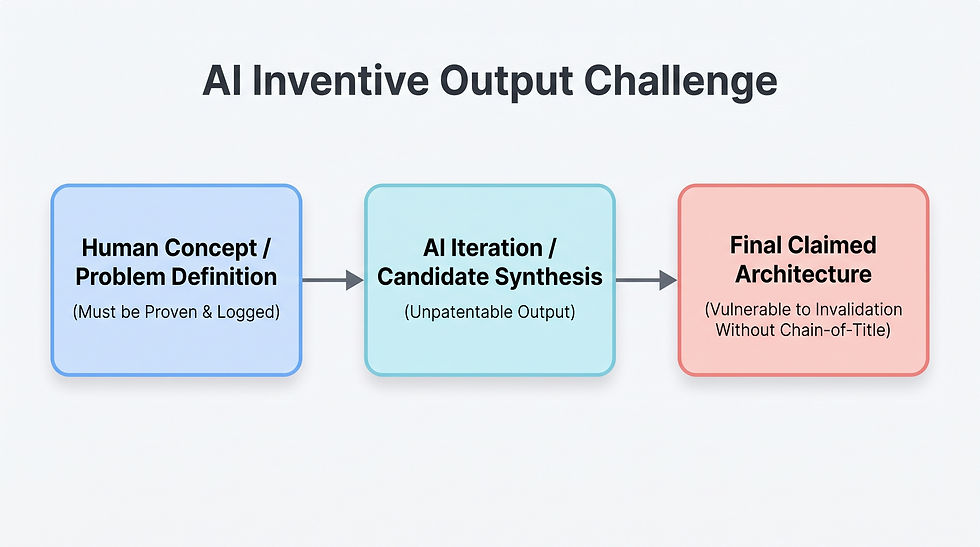
Inventorship Standards (Thaler v. Vidal)
Under the established precedent of Thaler v. Vidal (affirmed by the Federal Circuit and maintained across global offices), patent protection requires human inventorship. AI tools may be used during research, but the human inventor must provide significant contribution to the conception of the invention.
The Prompt Audit Defense: During patent litigation and M&A due diligence, defendants now routinely demand prompt logs, API calls, and developer workbooks. If a claimed formula or software architecture came directly from an autonomous system without documented human conception, the patent faces invalidation for improper inventorship or inequitable conduct.
The Rising PHOSITA Bar
Under 35 U.S.C. § 103, an invention is unpatentable if it would have been obvious to a "Person Having Ordinary Skill in the Art" (PHOSITA).
Patent offices and courts increasingly presume that the PHOSITA has access to state-of-the-art generative modeling tools.
As automated tools quickly synthesize structural permutations, chemical analogs, and software routines, the threshold for what constitutes an inventive step rises, narrowing defensible claim scope across engineering, life sciences, and software.
The Prior-Art Deluge
Automated technical disclosures published across open-access repositories create massive volumes of prior art. While companies use this strategy defensively to prevent competitors from patenting adjacent spaces, it presents real risks: synthetic "prior-art pollution" complicates examination and risks invalidating human inventions that were developed in parallel.
4. The Valuation Flight to Quality: The "Pre-AI Certified" Premium
In our April 2026 report, The Digital Big Bang: Transforming IP Management and Finance, we laid out the financial mechanics behind what we termed the authenticity bifurcation:
"When the marginal cost of creating synthetic content drops to zero, market capital does not disappear; it flees to verifiable scarcity. Audited, immutable catalogs with clean chain-of-title will command institutional debt and equity multiples that synthetic media cannot access."
That thesis is now driving M&A and IP asset finance.
The Diverging Valuation Spectrum:

Valuation Multiple
      ▲
      │       [PRE-AI HUMAN ASSETS]
 High │       • Audited chain of title
      │       • Clear training provenance
      │       • Defensible institutional multiples (15x–22x NPS)
      │
      │ ────────────────────────────────────────────────────────
      │
  Low │       [UNVERIFIED / SYNTHETIC OUTPUTS]
      │       • High volume, near-zero marginal cost
      │       • Safe-harbor and copyright uncertainty
      │       • Heavy multiple compression (<5x NPS)
      ▼
      └────────────────────────────────────────────────────────► Time (2024–2026+)
Why Pre-AI Music Catalogs Command a Premium
Unassailable Chain-of-Title: Institutional investors (such as Blackstone, Concord, and Hipgnosis) prioritize catalog acquisitions created and registered before the 2023 mass deployment of foundation models. These catalogs carry zero risk of "fruit of the poisoned tree" contamination, union clawbacks (such as the American Federation of Musicians' June 2026 labor suits over uncredited training models), or downstream takedowns.
Defensive Moats in Finite Streaming Pools: DSP royalty pools are zero-sum. As streaming services fight low-effort programmatic tracks; Deezer reports tens of thousands of fully synthetic uploads daily; platforms are pivoting to "artist-centric" payout models that penalize non-human or low-engagement audio. Verified legacy catalogs retain strong consumer engagement, defending Net Publisher’s Share (NPS) multiples (commanding steady 15x–22x+ valuations).
The Gold Standard for Licensed Training Data: The safest way for AI developers to avoid billions in statutory liability is to train on fully cleared, unencumbered catalogs. Pre-AI masters offer clean, undisputed source material, allowing rightsholders to command significant licensing fees and equity participation.
The Deflation of Functional Stock Music: Conversely, non-branded production music, background cues, and generic sync libraries face valuation compression. Asset types easily approximated by prompt inputs are seeing market multiples drop below 5x, accelerating the shift toward culturally recognisable, authenticated catalogs.

5. Strategic Takeaways for Creators, Businesses, and IP Owners
In an ecosystem flooded with synthetic generation, defensibility depends on verified provenance. At SOLO IP Management, we recommend four practical steps:
Audit and Secure Your Chain-of-Title: Register works with undisputed evidence of authorship. Utilizing secure registration environments; such as SOLO’s IP Vault; creates an immutable, timestamped record of human creation, protecting your rights against future misappropriation claims.
Integrate Trademark and Publicity Protections: Do not rely solely on copyright to protect your identity. Register your brand names, sound signatures, and recognisable brand identifiers under regional trademark registers to build defenses against synthetic impersonation.
Log Technical Conception for Patent Applications: If your R&D teams use AI code generators or synthesis tools, maintain strict documentation. Log human ideation, prompt workflows, and architectural proofs to establish valid inventorship.
Differentiate Legacy Assets from Commodity Content: If you hold a pre-2023 catalog of music, designs, or proprietary software, catalog it clearly. As the market places a premium on clean provenance, having verified pre-AI IP will be your strongest asset in valuations, licensing negotiations, and enterprise sales.
Are your creative assets insulated against market dilution? Explore the SOLO IP Platform to discover how our IP Vault, portfolio audits, and bespoke management services help you register, defend, and maximise the value of your intangible assets.
Stay in the loop; subscribe to our newsletter


Comments